Blog Home
Hart for the Art: Hart Print Delivers High Quality Digital Printed Cans at Costs for Any Operation
Published: June 30, 2026
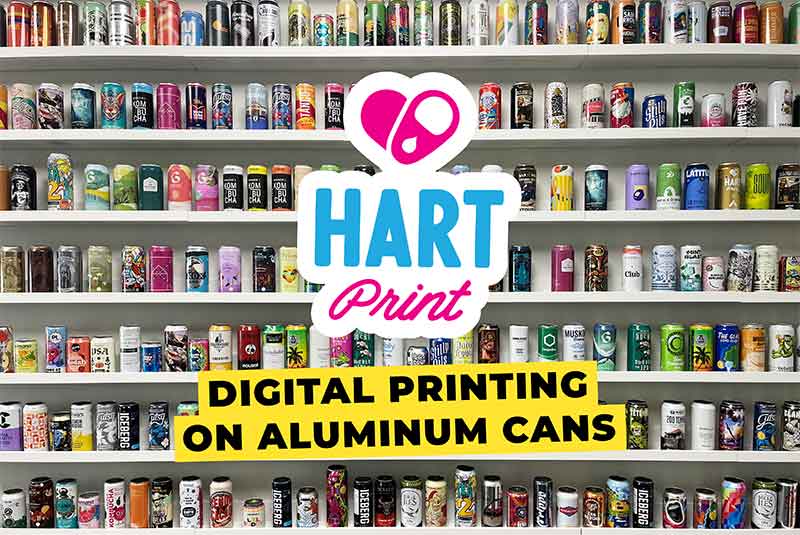
According to a Brewers Association report, there are still more than 9,500 U.S. craft breweries. Standing out on the shelf or in the liquor store remains an integral piece of today’s craft beer climate. Having a unique presentation, such as a digitally printed can, could very well make the difference.
With the craft beer industry heavily saturated, it’s vital to set your business apart from others, especially if it fits nicely into your tight budget. That’s exactly what Hart Print has been doing for countless companies over its eight-year span.
We chatted with Hart Print Business Development Manager Pat Campbell and Head of Creative Martha (Marty) Gabs to learn more about Hart Print, how it sets itself apart from competitors, which size of operation is best suited for its services, and how it helps breweries grow.
(Photography courtesy of Hart Print)
What Is Hart Print?
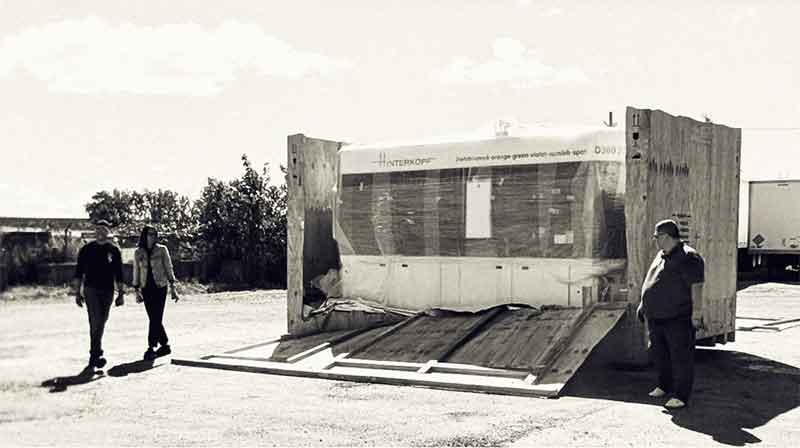
Alex Anishin, Stephanie Hart, and JP Paradis welcoming printer #11 | Photography courtesy of Hart Print
The company began as a “MBA project that took off” at Concordia University in 2018, with eventual co-founders Stephanie Hart, Jean-Pierre Paradis, and Alex Anishin. The trio set out to find the most sustainable and friendly way to print cans.
Hart was an investor in a microbrewery and had dealt with the issues that come with product limitation and non-recyclable sticker labels. She provided the concept and dream, while Anishin spearheaded the R&D and Paradis engineered the company’s operations.
“They were always searching, knowing there was something out there that could allow customers to order what they want when they need it in a way that is environmental and in a way that looks really freaking great,” Gabs says. “In their search, they actually found something that could work.”
What they found, Gabs says, was a machine that printed on plastic tubes and aerosol cans.
“They said, ‘What if we replace this product with an actual rotating can?’” Gabs says. “Then it worked, and here we go! It’s basically your printer from the office, but on steroids. And it was the solution to all of those problems.”
The plan was also to cut out the middleman by printing the labels directly onto the cans. Gabs says the only printer capable of that required breweries to get “insane quantities.” Additionally, prior to Hart’s technology, breweries had pressure-sensitive labels (PSLs), basically adhesive labels, and unless you removed them from the can, they weren’t entirely recyclable.
“So this was the alternative to lower those MOQs [minimum order quantities] to fit for craft brewers,” Campbell says. “But also having the can be 100 percent recyclable.”
It’s important to the company that sustainability and flexibility go hand in hand.
“When you do things sustainably, you do things smart,” Gabs says. “But [it’s also important] to give people the freedom to order as much as they want to and have the flexibility to adjust the artwork in an environmentally conscious way.”
Gabs adds, “It’s the best of both worlds. And that’s why it’s up to us to be able to have both happening at the same time.”
Return to top
What Sets Hart Print Apart from Competitors?
Photography courtesy of Hart Print
“Experience is by far one of the major ones [that sets us apart from competitors],” Campbell says. “I mean, we invented the digital print technology on beverage cans.”
Gabs adds that Hart Print essentially had a three-year head start on all the competitors.
“Our level of support is so massive because we’ve been in it for a while that we’ve become like a partnership [with the client],” says Gabs.
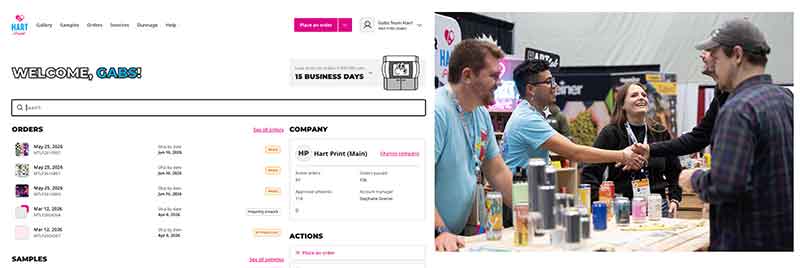
She specifically points to the company’s online portal, which Hart Print boasts that no other competitor has. The portal is essentially a one-stop shop for managing everything related to a customer’s printed cans. The portal gives customers easy access to independently manage their orders, upload artwork, request samples, track shipments, and communicate concerns. The system is designed to eliminate the need for back-and-forth emails and phone calls, providing users with a streamlined experience, saving time, improving visibility, and giving the customer more control over their day-to-day operations.
“We worked really hard to make custom servicing very accessible and self-managed by the customers,” Gabs says. “The online customer portal is really big for us.”
Campbell says that Hart Print has the most printers for creating these digitally printed cans, which allows them to be extremely flexible with clients, keeping lead times low and the turnaround from request to delivery fast.
“We also have the only in-house design team,” Campbell says, “which is a huge advantage too. Especially for a lot of these craft brewers, the brewer is the owner and is kind of wearing seventeen hats, and sometimes label design falls into that too. So we can help out with that.”
Hart Print provides another advantage for breweries.
“We’re the only ones that are vertically integrated with a can supplier,” Campbell says. In 2021, Hart Print was acquired by Ardagh Metal Packaging, which is one of the three largest global manufacturers of aluminum cans in the United States. “So we have a direct stream of inventory at all times.”
As an experienced digitally printed cans manufacturer, Hart Print also offers support that exceeds its competitors’.
“What we’ve noticed so far is that every customer is very different and they have different journeys and different ways of doing things, and we cater to all of it,” Gabs says. “The best perk, I think, at Hart Print is the number of humans who are the ones communicating with each other. It’s not like you have a machine, we don’t redirect to an AI … we have people that you talk to.”
Gabs says you can express where you are in your process, and any issues or concerns you have to be solved, and Hart Print delivers a human connection to resolve the problem.
“It’s a beautiful resolution because people keep coming back,” Gabs says. “So I have to say that the human connection is great.”
Return to top
How Does Hart Print Help Breweries Grow?
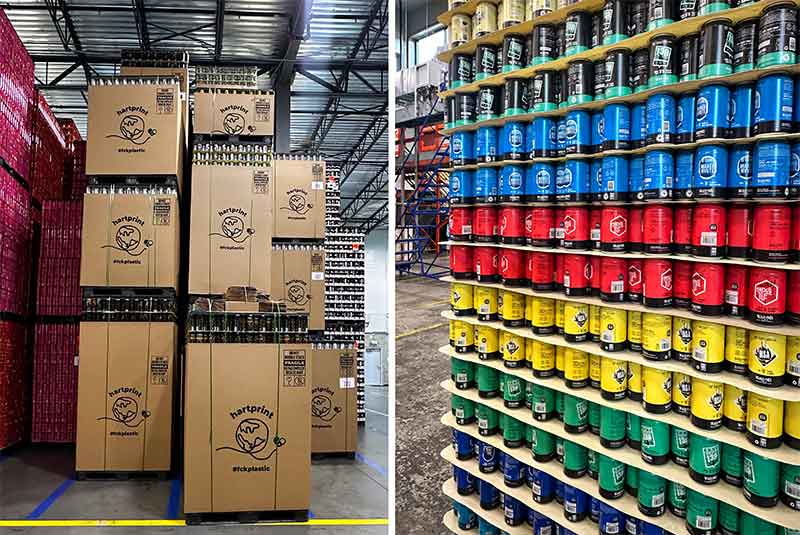
Hart Print prints orders of all sizes. Multiple SKUs on one pallet are also available. | Photography courtesy of Hart Print
Gabs says Hart Print will stop at nothing to help a brewery go to whatever heights they set out to achieve.
“Anytime a customer comes in, whatever their dream is, we know exactly where to help you, how to help you, because we’ve been in it for a while,” Gabs says. “If you need a co-packer, we have connections with co-packers. If you want to blow up … we’ll tell you how to do it.”
Gabs adds, “We’ve become cheerleaders of whatever they want to do because we have the ability to be flexible with them and help them get there.”
That flexibility extends to MOQs too.
“We do have the lowest MOQs in the industry,” Campbell says. “Our MOQs are a single pallet layer. A lot of other folks, it’s a whole pallet. We are a pallet layer, so for standard cans—12-ounce or 16-ounce or 19.2-ounce—that’s 389 cans.”
Gabs adds that low MOQs allow breweries to go to market faster by making small quantities of a release without being tied to a larger quantity.
“Print what you need when you need it,” she says. “It happens a lot when a customer submits artwork, and then they need to change the ABV from 5% to 4.5%. We make the change and get back on track within twenty-four hours.”
The single pallet layer of cans is for a single SKU or design. This allows breweries to do trial runs of beers with minimum commitment to rolls of PSL-style labels.
“That’s our small, small run,” Campbell says. “We could have a layer of lager cans, a layer of IPAs, a layer of bock, and have it be on the same pallet.”
Campbell adds, “We’re usually very comparable in cost to what anyone’s paying for their label – whether it’s the sticker PSL or the shrink sleeve—plus the can. So that’s where we compete.”
But Campbell then notes how Hart Print has the X factor. “The look and feel of the can is typically a lot more premium than a label or a shrink sleeve,” Campbell says.
When you combine low MOQs with premium design, it’s a recipe for success and growth.
“Craft beer is built on low MOQs, and how can you have a can that sits on the shelf that looks like a premium product,” Campbell says. “That’s kind of where it really shines. Back in the day, craft beer was that can with a sticker label. I think that those tides have shifted dramatically in the last five years. Now it’s what catches people’s eyes.”
Campbell notes, “People are drinking with their eyes, and what is catching their eyes is the cool-looking can and digital design.”
Case in point: Campbell says that Hart Print was recently at a trade show and helped a customer they work with redesign an existing brand.
“They didn’t know they weren’t happy with the can until they worked with our designers,” Campbell says. “We made a few small changes and made it pop. Now they want to change the design to what we did.”
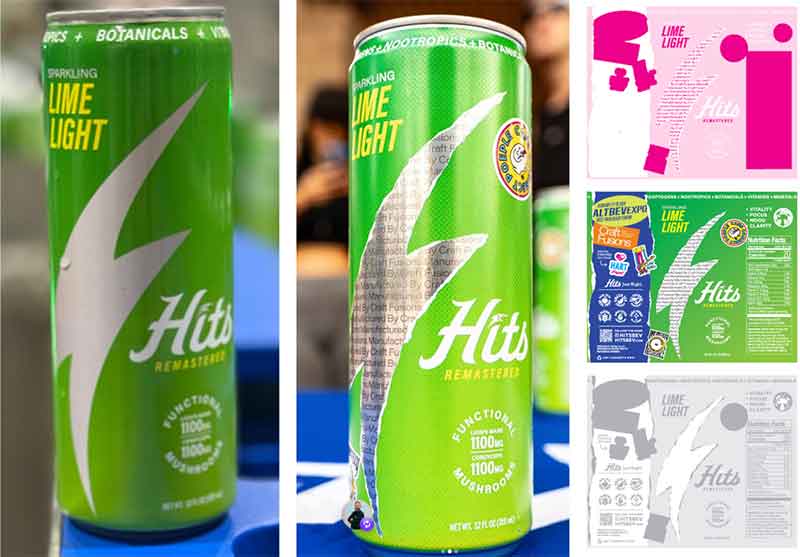
Hits can before on the left and after the Hart Print remake on the right | Image courtesy of Hart Print
Gabs points out that it was for a 4,000 can collaboration event with Hits x Hart Print x Alt Bev. Hart asked Hits to send the artwork they wanted to use for the event.
“Then we asked our favorite question: ‘Do we have permission to mess with your file?’” Gabs says. “Once they said yes, we went go-go-go. Our team took their file and enhanced it with crazy finishes… torn-metal effect, tactile textures, and selective gloss that mimicked stickers.
She adds, “Imagining results through setups is our jam. The creative hype was very cool, too. Design and tech nerding it out is a cool mix.”
Hits was impressed by the results. In comparison, Gabs says the original cans were somewhat basic. She notes that many printers print the file that they’re given, but that’s the basics.
“But we’ve always known that having access to graphics and design experts, humans, really, can help customers take their cans to another level,” Gabs says.
Campbell adds, “If you send the label and ask to make it better, we can do that.”
Return to top
Ready to Design Digitally Printed Cans with Hart Print?
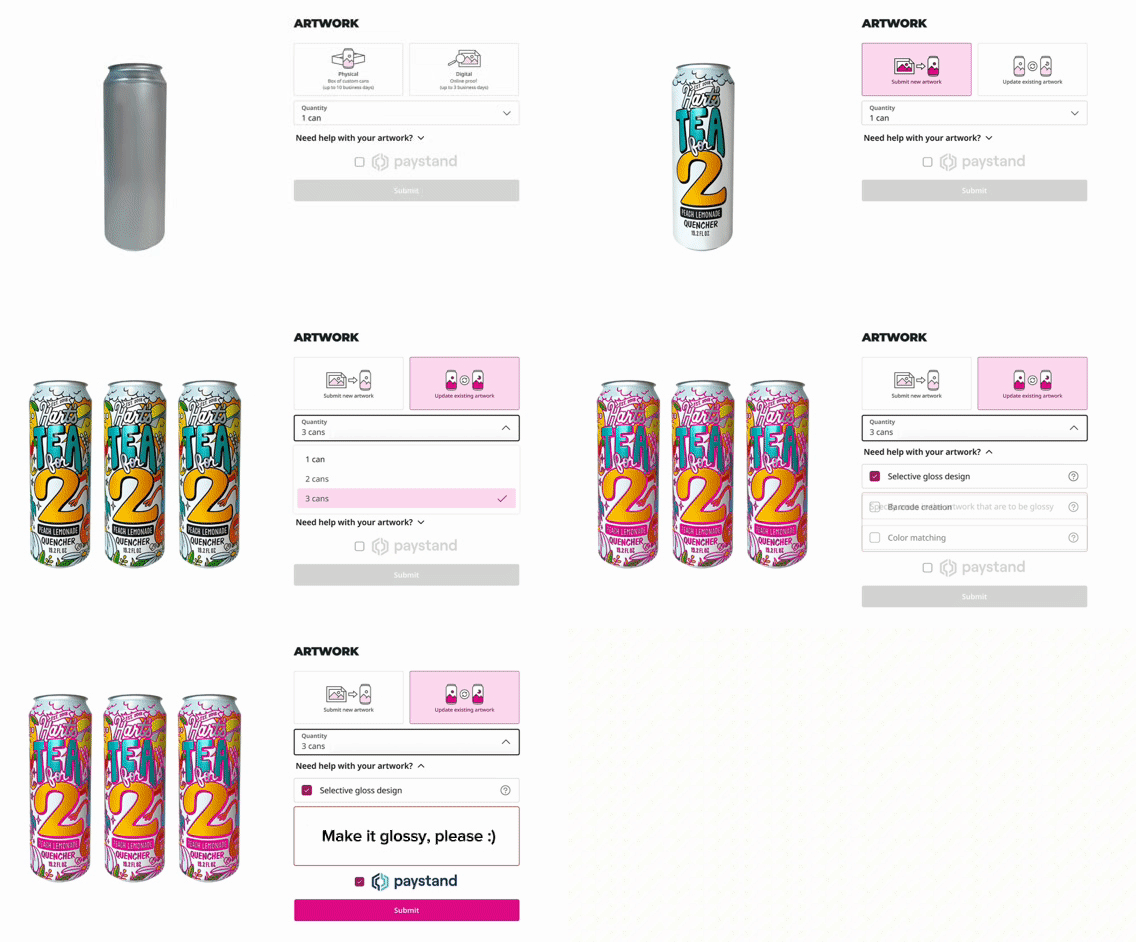
Image courtesy of Hart Print
If you’re a brewery ready to take your branding to the next level, Hart Print is just a click away from guiding you to a new-and-improved look.
“If you have a special collaboration or a commemorative beer,” Campbell says, “That’s a perfect time for us to come in and do that. It allows a whole lot of innovation and flexibility.”
That flexibility extends beyond email and phone requests, too. Hart Print also has an online portal that provides 24/7 access to a company’s ongoing orders, showing each step of the process.
“The portal is how we have been able to remain so flexible,” Gabs says. “While allowing the customers to have full control and visibility of their orders with us.”
Campbell adds, “And if you look at pricing for a single layer of cans versus ordering labels, it’s very reasonable.”
And this is not just for large operations either. Campbell notes that Hart Print’s “bread and butter are the little guys.” It is the only company offering an alternative for sleeves and PSLs at a low MOQ.
“We have customers like brewpubs, sometimes we have customers so small that they don’t have a garage door,” Campbell says. “We also work with some regional and national brands.”
Hart Print is headquartered in Montreal, Canada, with facilities in both Maryland and Illinois, and services companies in both the U.S. and Canada. Check out what Hart Print has done for others by visiting their website.
From there, go to hartprint.com, or reach out directly to Campbell at [email protected], or head to his calendar to book a time to chat.
Return to top
About Partner Provided Content
This content has been provided by one of our many Partners. Partner-provided content is designed to add value and expert insight into all aspects of the brewery and craft beverage industry. The content may contain ads and promotions. The views and opinions expressed in this content are those of the Partner and do not necessarily reflect the views of our company and associated brands.

About The Author
Giovanni Albanese
Giovanni is a content writer for Next Glass, contributing to the Ollie blog. He is a writer by day and a brewer/business owner by night, owning and operating Settle Down Brewery & Taproom in Gilroy, California.
Giovanni is passionate about a number of things, including history, documentaries and sports, but none more than reporting/writing and brewing beer. After receiving a radio broadcasting degree then a journalism degree from Salem State College in his home state of Massachusetts, he relocated to California in 2008.
Then, his writing career kicked off – covering sports, business, politics and more along the way – while concurrently dabbling in home brewing. The home brewing turned pro in 2021 when he launched SDB Brewing Company. Settle Down Beer officially opened in February.